Measure Twice, Sit Once: How to Buy a Sofa That Fits a Real British Lounge
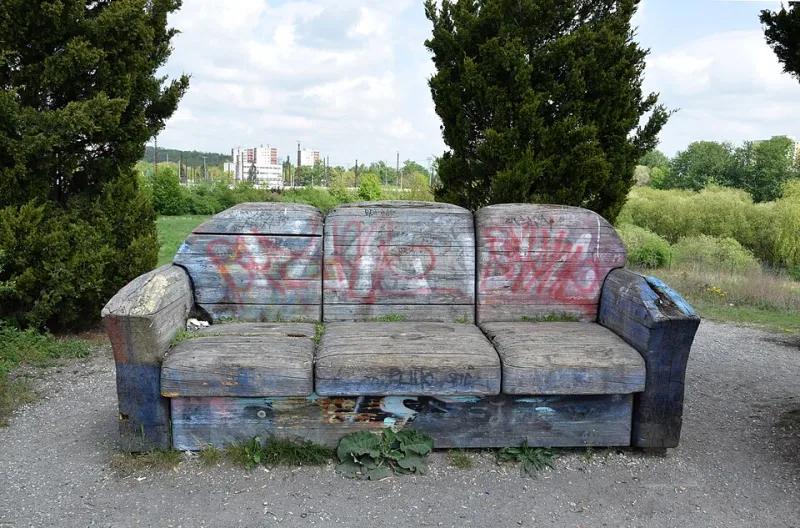
Photo: Singlespeedfahrer, CC0, via Wikimedia Commons
There's a particular kind of disappointment that comes from a sofa that doesn't fit. Not the shade being wrong, not the fabric being a bit shinier than the swatch — the fact that it won't go through the front door. It happens constantly, and almost always because the measuring stopped at the room and never reached the route.
So here's the unglamorous, genuinely useful version of a sofa guide: what to measure, what's inside the thing, and what to take to the shop.
Measure the route, not just the room
Start at the street and work inwards. You need the width of your front door with the door itself open — take 5cm off for hinges and handles. Then the width of the narrowest point in the hall. Then the tricky one: the turn at the bottom or top of the stairs, if there is one.
A sofa has three dimensions, and the one that catches people out is the diagonal. A two-seater that's 90cm deep and 180cm wide will not go around a 90-degree corner in a 1m-wide hallway no matter how you tilt it. Measure the height of the ceiling above the turn too, because tilting a sofa up on its end is often the only way through.
Also check the legs. Most sofas have screw-off legs, which buys you 10–12cm of height and can be the difference between clearing a doorframe and giving up. Ask before you buy; some frames have fixed feet.
The British living room problem: bays, alcoves and chimney breasts
Our housing stock is full of rooms that were never designed around modern furniture. The Victorian terrace with a bay window and two alcoves either side of a chimney breast is a lovely shape and a nightmare to furnish — a standard three-seater won't sit square against anything.
Two options work well. A pair of smaller sofas or a sofa plus two chairs lets you use the bay for seating and the alcoves for storage. Or go for a compact two-and-a-half seater placed off the chimney breast, angled towards the fireplace, with the bay left as a reading corner. Measure the alcove width and depth before you fall for anything online; 4cm is all it takes.
In a small modern lounge — the sort in a new-build where the room is 3.2m by 3.5m — resist the deep corner sofa. They eat floor space, block the window and make the room feel like a waiting area. A 1.8m sofa with slim arms and a shallow footprint will seat three at a push and leave the room breathing.
What's actually inside
This is where the money goes, and where the shop assistant's vocabulary gets confusing.
Foam is the workhorse. High-density foam holds its shape, needs little maintenance and is the sensible choice for a family sofa that gets used daily. Cheap low-density foam is what makes a sofa feel wonderful in the showroom and dreadful eighteen months later.
Fibre (polyester wadding) is soft and squashy and needs plumping, like a pillow. Lovely for a formal room, tiring for everyday use.
Feather is luxurious and high-maintenance: it shifts, it flattens, it needs a daily shake. Great in a spare room, hard work in a household with a dog.
Pocket springs wrapped in foam give a firmer, more supportive seat that resists sagging over years. Worth the extra if the sofa is your main sitting spot.
Most good sofas combine two of these — a foam core with a fibre wrap, say. Ask what's in the seat cushion and what's in the back, because they're often different, and ask whether replacement cushions can be bought separately. That single question tells you a lot about how long the sofa is meant to last.
Comfort, in numbers
Seat height matters more than most people realise. Around 45cm from floor to the top of the seat cushion suits most adults; much lower and getting up becomes a project. Seat depth is the other one: 55–60cm is upright and supportive, 65cm plus is a slouch, and if you're tall, deep seats are where your knees end up.
Sit for at least ten minutes in the shop. Sit in the actual corner you'd sit in at home. Lean back. If it's a sofa bed or a recliner, open it fully there and then, and check it still fits the space once extended.
Fabrics that survive real life
Tight-weave fabrics — flat weaves, chenille, microfibre — are the practical answer for pets and children. Claws and crumbs don't sink in, and most wipe clean.
Velvet is more resilient than its reputation suggests, but it shows every handprint and compress mark. Fine for a grown-up room, less so for a household with a spaniel.
Leather wipes down brilliantly and ages well, but claws do scratch it and a cold seat on a January morning is a real thing.
Loose covers are the quiet hero of family life. If the covers can be removed and washed, or replaced entirely in five years, the sofa gets a second life instead of a trip to the tip.
Ask for a swatch and take it home. Fabric that looks calm under shop lighting can turn out much brighter in a south-facing room, and a sample rubbed between your fingers tells you more about pilling than any label.
The checklist to take to the shop
- Front door width, with the door open
- Narrowest hallway point
- Stair turn dimensions and ceiling height above it
- Room dimensions and a rough sketch with doors and radiators marked
- Alcove and bay measurements to the nearest centimetre
- Whether legs are removable
- Seat height and seat depth you actually want
- What's in the seat cushion, and can it be replaced
- Cover care: washable, dry-clean or sponge only
- Lead time and delivery access restrictions
On timing and delivery
Made-to-order sofas commonly run six to ten weeks, sometimes longer for specialist covers, so order before you need it rather than the week before a birthday. Check whether delivery includes bringing it into the room of choice, and whether the couriers will remove packaging — in a small terrace with a tight hall, that detail matters more than the price of the fabric protection.
Buy the sofa that fits the room you have, not the one you wish you had. It's the least romantic advice in this article and the most likely to leave you happy in three years' time.