After the Clocks Go Back: A Living Room Lighting Plan for Long Dark Evenings
There is a specific hour in a British winter when the living room stops being a room and becomes a decision. The curtains are shut, the heating has clicked on, and the only light in the house is coming from a pendant that seems determined to make everything look like a doctor's waiting area. Somewhere between the school pick-up and dinner, you flick that switch and the whole mood of the evening is set — badly.
That's the 6pm problem. And the good news is that it's almost entirely solvable with two lamps, one dimmer and a bit of restraint.
First, give the ceiling light a rest
Most British living rooms are lit by a single pendant hanging from the middle of the ceiling. It's a practical hangover from an era when one bulb per room was a luxury, and it does exactly one job: it floods the space evenly and flattens it completely. Nobody looks good under it, no corner feels inviting beneath it, and it makes a Tuesday evening in November feel like the last hour of a Sunday in a supermarket.
You don't need to remove it. You need to stop it being the first thing you reach for. Treat the pendant as a background layer for cleaning, for finding a lost earring, for the moment you're carrying a full laundry basket up the stairs. Treat the lamps as the lights that actually run the evening.
Three layers, doing three different jobs
Lighting designers talk about layers, which sounds grander than it is. In practice, it means this: something soft and general, something directed at a task, and something small and low for atmosphere.
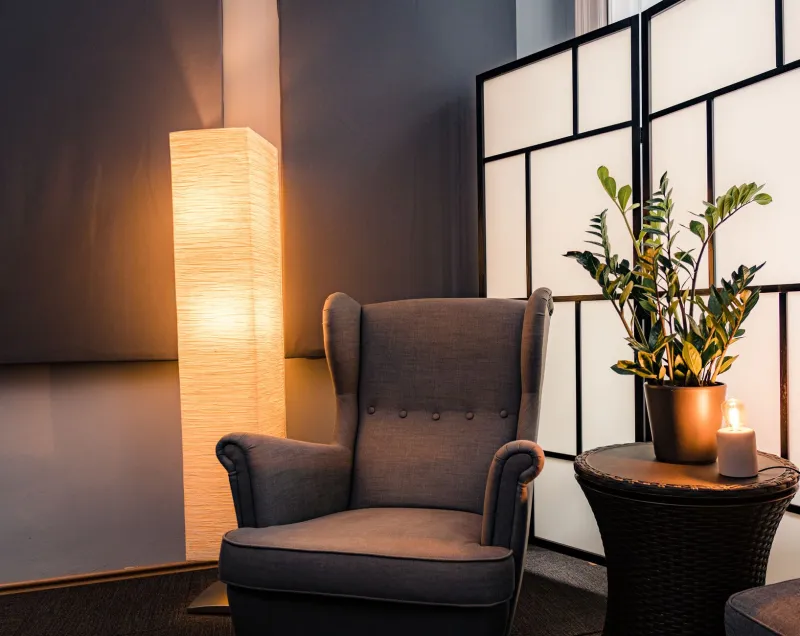
The soft general layer is usually a floor lamp in the corner furthest from the door — the one you'd otherwise never sit in. A shaded floor lamp with a linen or pleated shade throws light up the wall and across the ceiling, which is exactly what a room with a single pendant is missing.
The task layer is a table lamp beside the sofa, at roughly shoulder height when you're sitting down. That's the light you read by, and crucially it's the light you can angle away from a television screen. Books, knitting, a crossword, the back of a takeaway menu: all better with a lamp to one side rather than a bulb overhead.
Then the atmosphere layer — a small lamp on a sideboard or a shelf, a picture light over the mantelpiece, or even a decent battery candle in a lantern. It does nothing practical whatsoever and that's the point. It gives the eye somewhere restful to land when the rest of the room is dim.
The bulb number that actually matters
Here's where a lot of warm, careful lamp-buying gets quietly ruined at the last hurdle. You can spend a fortune on shades and still end up with a room that feels like a changing cubicle, because the bulbs are wrong.
Look for 2700K on the box. That's warm white, the colour of an old incandescent bulb, and it's the temperature that makes a living room feel like an evening. 3000K is fine for a kitchen. 4000K and above belongs in a garage, an office corridor or a dental surgery, and it will make your oak sideboard look grey.
Also check the lumens rather than the watts. A 400-lumen bulb is roughly the equivalent of an old 40W, which is about right for a table lamp. People over-brighten lamps constantly, then wonder why the room feels harsh — the answer is usually a 800-lumen bulb doing the work of a 400.
And please, buy dimmable LEDs even if the fitting isn't dimmable yet. You'll thank yourself later.
Where to put the dimmer (and how)
Ideally, the dimmer is on the wall by the door and it controls everything. Realistically, in most UK homes, it controls the pendant and nothing else — which is why the smart plug has become the quiet hero of the winter living room.
A simple plug-in dimmer or a smart plug with a dimmable lamp gives you a slider on your phone, and that is genuinely useful in a rental where you can't touch the wiring. The trick is to set the lamps to about 40 per cent at six o'clock, then drop them further as the evening goes on. Light that stays at one level all night feels static; light that gently falls feels like the room is winding down with you.
If you are rewiring or having sockets changed, put a dimmable circuit on the living room lamps rather than the ceiling. Every electrician will look at you oddly for about ten seconds and then agree.
Three very different rooms, one idea
The Victorian terrace
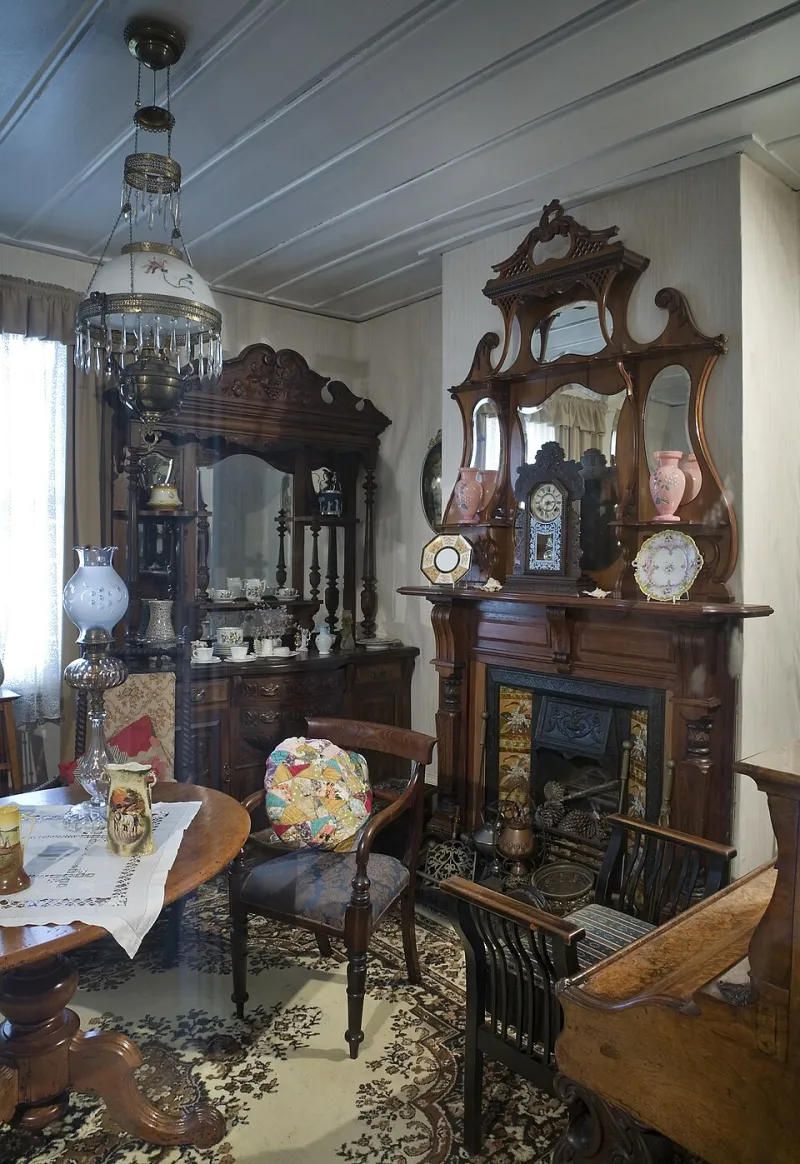
High ceilings and a chimney breast are lovely in daylight and awkward at night — the pendant hangs in the middle of all that air and the alcoves go dark. Put a floor lamp in one alcove and a slim table lamp on a console in the other, and you've effectively re-lit the room without touching the ceiling. Watch out for original cornices throwing odd shadows if a lamp points straight up; a shade with a wider bottom softens it.
The 1930s semi
These rooms tend to be long, with a bay window at one end and a doorway at the other, and a pendant stuck in the middle doing its best. Put your brightest lamp at the bay end — that's where the daylight went, so it's where the evening light should replace it — and a lower, warmer lamp by the fireplace. Two sources at opposite ends of a long room stop it feeling like a corridor.
The new-build box room
Small rooms have nowhere for light to hide, so a single bright source bounces off every pale wall and makes the space feel like a lift. Go for two modest lamps rather than one big one — a small table lamp on a narrow console and a clip-on or a slim floor lamp in the corner — and keep both warm and dimmed. Avoid uplighters aimed at a white ceiling; it'll look like a hospital corridor with a nice sofa in it.
The six o'clock routine
None of this needs to be complicated. At about six, close the curtains, switch the pendant off, turn on the floor lamp at 60 per cent and the table lamp at 50, and leave the little accent light alone until you actually sit down. By nine, everything should be lower than it was at seven.
That's the whole method. It costs nothing if you already own the lamps, and it changes the feel of a November evening more than any new sofa ever will. Your living room has been waiting for this since about 2019.