Warm Walls, Better Flow: Planning Rooms Around the Radiator You Already Have
Most UK homes have at least one radiator in a place that makes us sigh. Under the window, slap-bang in the middle of the only usable wall, or tucked behind a door that barely opens. The instinct is to ignore it, build around it, or hide it behind the sofa and hope for the best. But a radiator is a fixed point, a bit like a fireplace or a chimney breast: once you accept it, the rest of the room becomes easier to plan.
Start with the heat map, not the furniture plan
Before you move a single chair, look at where the radiators sit and how the room is used. A radiator needs air around it to work properly. If a sofa, armchair or dining chair is pressed right against it, you are warming the back of the furniture rather than the room. As a general rule, leave a hand's width or more of clear space in front of and above a radiator, and keep curtains from draping over the top. Make sure the valves, especially thermostatic radiator valves, are easy to reach. If you cannot turn a radiator down without crawling behind a sofa, the layout is already working against you.
This is not about leaving a sad, empty strip of floor around every radiator. It is about giving the heat somewhere to go. Once you know which walls are genuinely out of bounds for bulky furniture, you can stop trying to force a layout that was never going to feel comfortable.
Living rooms: pull the sofa clear
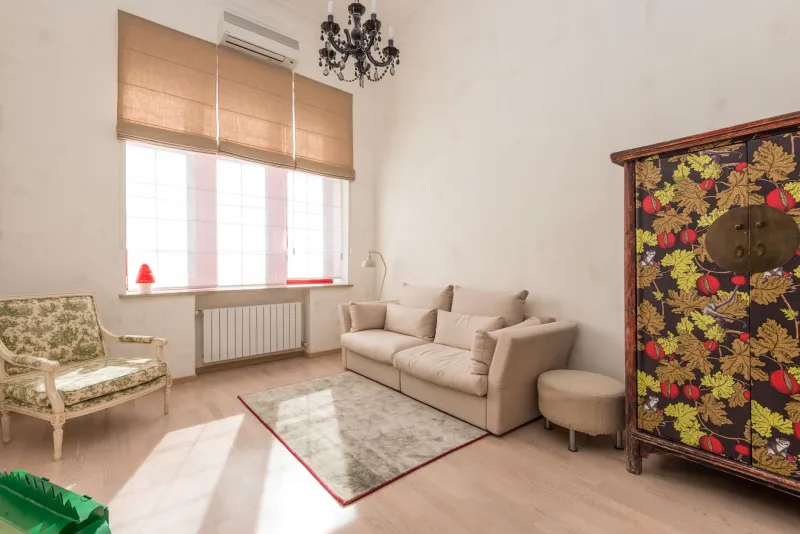
In a living room, the radiator under the window is often the quiet reason the sofa ends up floating in an odd spot. Rather than pushing the sofa back against the radiator, try pulling it forward and treating the gap as a deliberate walkway. In a narrow lounge, a slim console behind the sofa can make that gap feel purposeful, as long as it does not block the heat. If the room is too small for that, arrange the seating at a right angle to the radiator wall instead. An armchair angled towards the fireplace or television can keep the window wall clear without making the room feel half-finished.
If the radiator is on the only long wall, think in zones. A pair of low armchairs with a small side table can sit slightly forward of the radiator, leaving space for heat to rise. Avoid the temptation to build a deep storage unit around it. Shallow shelving beside the radiator is useful; shelving directly over it tends to trap warmth and make the wall look cluttered.
Dining rooms: give chairs room to breathe
A dining table pushed against a radiator is one of those arrangements that looks fine in a photograph and feels wrong in real life. Nobody wants the back of their chair radiating heat while they eat. If the table must sit near the radiator, leave enough space for chairs to pull out comfortably and for air to move. A bench on the opposite side of the table can free up a little extra room, but do not use it as an excuse to press the whole dining set against the wall.
In a smaller dining room, use the radiator wall for a slim console or a tall, narrow bookcase positioned to one side. A mirror above the console will bounce light around without blocking heat. If you have a radiator cover, make sure it has a slatted or gridded top and open sides so warm air can escape. A solid box with a decorative front may look neat, but it can turn a useful radiator into a very expensive piece of furniture.
Hallways and narrow rooms: make the radiator a marker
Hallways are where radiators often feel most awkward, especially in terraced houses where the front door opens straight into a narrow passage. Rather than pretending the radiator is not there, use it as a marker for a practical zone. A slim shoe bench opposite, a row of hooks further along, and a narrow runner on the floor can create a sense of order. Keep the radiator itself clear so it can take the chill off the space when someone comes in wet and cold.
In a box room or small bedroom, do not push the bed against a radiator to save space. The heat has nowhere to go, and the person sleeping nearest the wall will feel it. Try the bed on the opposite wall, even if it means losing a little floor space elsewhere. A tall, narrow bedside table uses less room than a wide one and keeps the radiator accessible.
Window seats and slim shelves: clever, not cramped
A window seat can be a lovely feature, but it is not a magic solution for a radiator underneath. If the radiator sits below the window, a built-in seat over the top will usually trap heat and make the radiator harder to control. A better approach is to keep the window area clear and use a freestanding bench to one side, or to move the radiator if the room is being renovated anyway. If you already have a window seat and the radiator is elsewhere, use it as a place to sit and read rather than a dumping ground for cushions and paperwork.
Slim shelves are more forgiving. A shallow shelf unit beside a radiator can hold books, lamps and the inevitable bits and pieces without blocking the heat. Just avoid hanging heavy curtains or long throws over the radiator, and do not stack shelves so close that you cannot reach the valves.
Paint and colour: stop apologising for it
A radiator does not have to be a white blob you pretend not to see. Painting it the same colour as the wall is the simplest way to make it recede, especially in a small room. In a period property, a radiator painted in the same soft off-white or muted green as the woodwork can look as though it belongs. If you want to make a feature of it, choose a colour that matches the room's scheme rather than a random metallic finish. A dark radiator on a dark wall can look smart and deliberate; a bright white one on a deep coloured wall will always draw the eye.
When the layout still fights back
Sometimes the radiator is in exactly the wrong place, and no amount of clever styling will fix it. In that case, consider whether a plumber could move it, or whether a vertical radiator could free up a useful stretch of wall. This is not a decision to rush, but it is worth costing before you spend money on furniture that never quite fits. In the meantime, keep walkways clear, use rugs to define seating areas, and let the radiator do its job. A warm room with a slightly unusual layout is usually more comfortable than a perfectly styled one where everyone is sitting in a draught.